Empty Tomb
빈 무덤
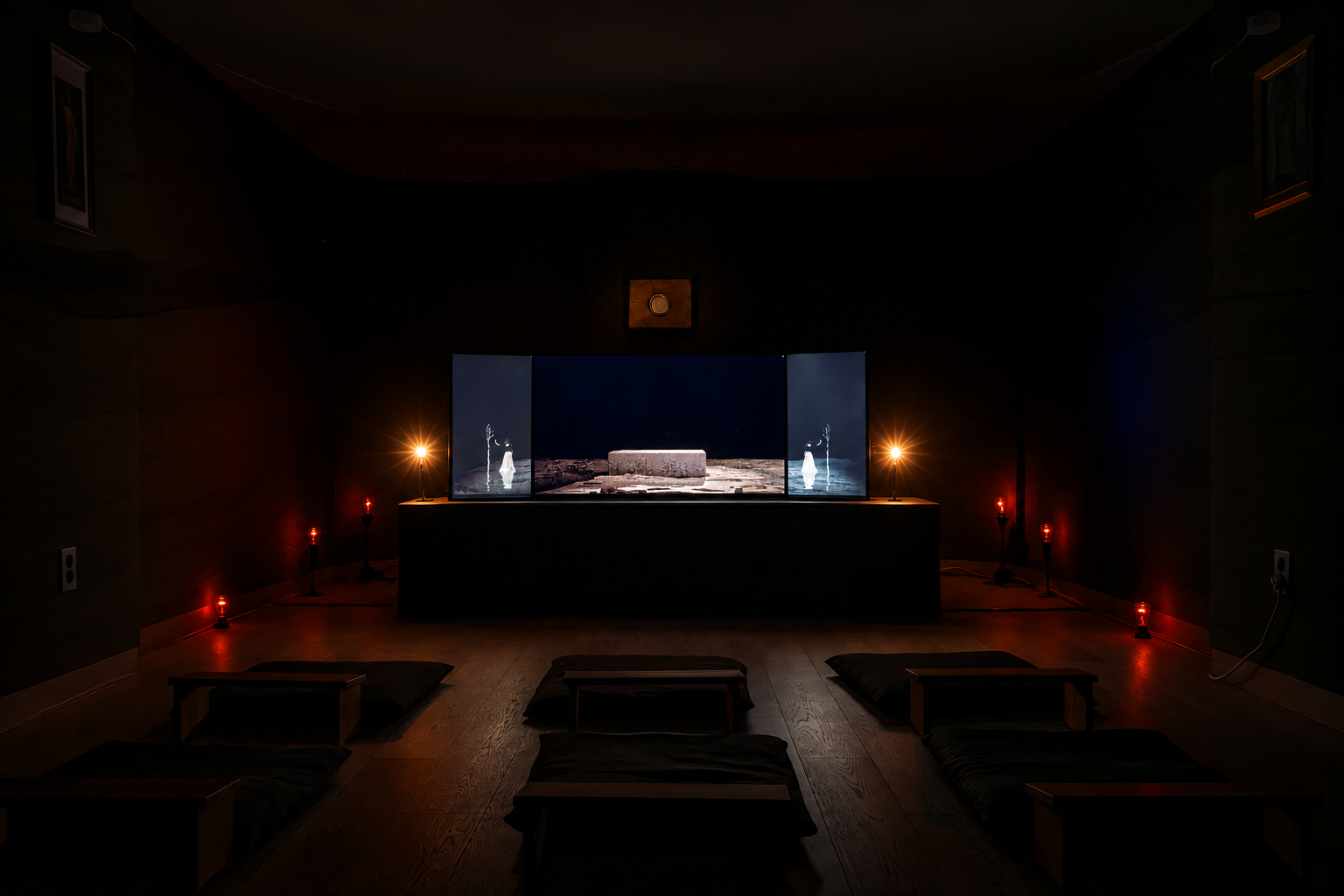
Three-channel video with synchronised lighting
빈자리 — 붙잡을 수 없는 현존
The empty place — a presence that cannot be held
천이 들어 올려진 뒤 그 아래에 몸이 없다. 《빈 무덤》은 이 짧은 장면을 통해, 감춰진 대상을 보게 되리라는 기대와 아무것도 드러나지 않는 결과 사이에 시간을 만든다.
여기서 천을 걷는 일은 대상을 더 선명하게 보여주기 위한 절차가 아니다. 몸의 윤곽을 지녔던 표면이 그 몸에서 분리되고, 관객의 시선은 형상에서 빈자리로 옮겨 간다.
이 작업은 이미지가 현존을 드러내는 방식과, 드러난 것을 소유하려는 시선의 한계에 관한 연구에서 출발했다. 로완 윌리엄스의 빈자리와 비소유성에 관한 논의는 그 질문을 구체화하는 계기였다.
한 번도 채워지지 않은 공간과 몸이 놓였다가 떠난 공간은 같지 않다. 돌과 천은 지금 없는 몸의 흔적을 남기지만, 그 흔적은 몸 자체를 대신하지 않는다.
천은 이 차이를 드러내는 물질이다. 덮고 있던 때에는 몸의 윤곽을 만들고, 떠오른 뒤에는 그 윤곽과 몸이 더 이상 일치하지 않음을 보여준다.
After the cloth rises, there is no body beneath it. Empty Tomb gives duration to the interval between an expectation—that a concealed subject will become visible—and an outcome in which nothing is revealed.
Lifting the cloth is not a procedure for making its subject clearer. A surface that held the outline of a body separates from that body, shifting attention from a figure to the place it has left.
The work emerged from research into how images disclose presence and the limits of a gaze that would possess what it sees. Rowan Williams’s discussions of emptiness and non-possession helped to give this question a more precise form.
A space never occupied and a space left by a body are not the same. Stone and cloth retain traces of the body that is no longer there, but those traces cannot replace the body itself.
Cloth makes this difference tangible. While covering the body it forms an outline; once raised, it reveals that outline and body no longer coincide.
들어 올려진 천 — 시선이 움직이는 자리
The lifted cloth — where the gaze begins to move
어두운 화면 한가운데, 돌 위에 천으로 싸인 몸이 놓여 있다. 조금씩 빛이 들어오다가 작은 종소리와 함께 천이 떠오른다. 바로 그 순간, 천 아래에 있어야 할 몸이 없다는 사실이 드러난다.
천은 들어 올려지지만 감춰진 몸을 시선에 돌려주지 않는다. 그 움직임은 빈 돌에 머물던 시선을 위로 옮기며, 대상으로 고정할 수 없는 움직임을 남긴다.
몸을 보여주지 않는다고 해서 몸의 경험이 지워지는 것은 아니다. 표면의 접힘과 무게, 돌의 질감과 떠오르는 속도는 사라진 몸을 구체적인 감각의 문제로 남겨 둔다.
천·돌·빛·시간은 함께 작동한다. 긴 기다림과 느린 상승은 장면을 즉시 해독하는 대신 시선이 달라질 시간을 만든다. 측면의 형상과 실제 조명의 변화는 화면의 움직임을 방 안의 경험으로 잇는다.
성체조배실에 설치되었을 때 이 영상은 기존 감실 아래에 놓였다. 화면 속의 빈자리와 실제 장소는 서로 다른 층위로 남는다. 영상은 공간 전체를 대신하기보다 그 장소를 바라보는 시간에 개입한다.
작품은 연구의 결론을 도해하지 않는다. 천이 움직이는 시간 안에 몸의 흔적과 부재, 바라봄과 붙잡을 수 없음의 관계를 남겨 둔다.
At the centre of a dark screen, a cloth-wrapped body lies on stone. Light gradually enters, then a small bell sounds and the cloth rises. At that moment, the absence of the body expected beneath it becomes apparent.
The lifted cloth does not return the concealed body to view. Its movement draws the gaze upwards from the bare stone, leaving a motion that cannot be fixed as a possessed object.
Withholding the body from view does not erase bodily experience. The folds and weight of the surface, the texture of stone and the pace of ascent retain the absent body as a question of perception.
Cloth, stone, light and time work together. The long wait and slow ascent allow attention to change rather than delivering an immediately legible scene. The side figures and changes in physical lighting connect movement on screen to the experience of a room.
When installed in the Adoration Chapel, the video was placed below the existing tabernacle. The empty place on screen and the actual location remain distinct. The image intervenes in the time spent looking at a place without replacing that place.
The work does not illustrate a research conclusion. Within the cloth’s movement it holds relations between the body’s trace and absence, looking and the impossibility of possession.
참고문헌과 글의 바탕References and source essay
작가의 논문 「들어 올려진 베일: 로완 윌리엄스, 데이비드 벤틀리 하트, 그리고 빈 무덤」(9월 15일 원고)을 바탕으로 웹페이지에 맞게 재구성했다. 아래는 이 글과 관련된 주요 문헌이다. 천의 움직임과 ‘앞서 가심’을 연결하는 설명은 작가의 작품 해석이며, 성서 본문의 직접적인 주해적 결론과 구분한다.
Adapted for this page from the artist’s essay “The Lifted Veil: Rowan Williams, David Bentley Hart, and the Empty Tomb” (15 September manuscript). Selected references follow. The connection between the cloth’s movement and Christ’s going ahead is the artist’s interpretation of the work, distinguished from a direct exegetical conclusion about the biblical text.
- Williams, Rowan. “Between the Cherubim: The Empty Tomb and the Empty Throne.” In On Christian Theology, 183–196. Oxford: Blackwell, 2000.
- Hart, David Bentley. The Beauty of the Infinite: The Aesthetics of Christian Truth. Grand Rapids: Eerdmans, 2003.
- Quash, Ben. “Brought into the Fold.” In Image as Theology: The Power of Art in Shaping Christian Thought, Devotion, and Imagination, edited by Mark McInroy, Casey Strine, and Alexis Torrance, 181–201. Turnhout: Brepols, 2022.
- Hills, Paul. Veiled Presence: Body and Drapery from Giotto to Titian. New Haven: Yale University Press, 2018.