Empty Tomb
빈 무덤
Three-channel video with synchronised lighting
빈자리 — 붙잡을 수 없는 현존
The empty place — a presence that cannot be held
이 작업은 30일 피정 중의 한 기도 체험에서 시작되었다. 전날 나는 예수의 현존을 강하게 경험했다. 다음 날에는 그분의 옷자락 하나하나를 흠숭하며 한 시간을 보냈다. 그렇게 59분이 지났을 때, 한순간에 그분의 몸이 사라졌다. 옷은 그대로 남았지만 그 안에 있어야 할 몸은 없었다.
그때 나는 전날 만났던 예수의 모습마저 보내드려야 한다는 것을 깨달았다. 아무리 강렬하고 아름다운 체험도 내가 소유한 예수의 형상이 되어서는 안 되었다. “나를 붙잡지 마라”는 말씀은 접촉의 금지라기보다, 내가 알고 있다고 생각한 모습에 그분을 가두지 말라는 요청으로 다가왔다. 이 체험에서 〈나를 만지지 마라〉가 시작되었고, 몸이 사라진 뒤 옷만 남은 이미지는 〈빈 무덤〉의 출발점이 되었다.
로완 윌리엄스는 빈 무덤을 ‘빈 왕좌’와 연결해 읽는다. 요한복음에서 몸이 놓였던 자리의 머리맡과 발치에 앉은 두 천사는, 그 사이에 어떤 형상도 놓이지 않았던 시은좌의 두 그룹을 환기한다. 이 독해에서 빈자리는 그리스도를 이미지나 공동체의 소유로 만들 수 없음을 드러낸다. 부활하신 분은 제자들보다 앞서 가시고, 붙드는 손을 멈추게 하며, 알아보는 순간에 사라지신다.
그러나 나는 한 번도 형상으로 채워지지 않은 자리와 한 몸이 놓였다가 떠난 자리 사이의 차이에 주목한다. 빈 무덤은 처음부터 비어 있던 공간이 아니다. 몸이 그곳에 놓였고, 이제 죽음에 붙들려 있지 않다. 그러므로 “여기 계시지 않는다”는 말은 부재에서 끝나지 않는다. 그것은 “너희보다 앞서 가신다”는 방향을 연다.
무덤에 남은 천을 부활의 물증이나 믿음의 직접적인 원인으로 단정하려는 것은 아니다. 요한복음은 제자가 “보고 믿었다”고 말하면서도, 그가 정확히 무엇을 보았고 믿었는지 명시하지 않는다(요한 20,6–9). 내가 주목하는 것은 그 장면에서 천이 갖는 물질적·서사적 힘이다. 몸을 보여주지 않으면서도, 한 몸이 이곳을 지나갔다는 사실과 그 몸이 더는 이곳에 붙들려 있지 않음을 함께 생각하게 한다.
This work began with a prayer experience during a thirty-day retreat. The day before, I had strongly experienced Jesus’ presence. The following day, I spent an hour venerating each fold of his garments. After fifty-nine minutes, his body suddenly disappeared. The clothes remained, but the body that should have been within them was gone.
I realised that I had to release even the image of Jesus I had encountered the previous day. However intense or beautiful an experience might be, it must not become an image of Jesus that I possess. “Do not hold on to me” came not so much as a prohibition of touch as a request not to confine him within the form I believed I knew. Noli Me Tangere began with this experience; the image of clothes remaining after the body had disappeared became the starting point for Empty Tomb.
Rowan Williams reads the empty tomb alongside the empty throne. In John’s Gospel, the two angels at the head and feet of the place where the body lay recall the cherubim of the mercy seat, between whom no image was placed. In this reading, the empty place resists making Christ the possession of an image or a community. The risen one goes ahead of his disciples, interrupts the hand that holds, and disappears at the moment of recognition.
Yet I attend to the difference between a place never occupied by an image and a place where a body lay and then departed. The tomb was not empty from the beginning. A body lay there and is no longer held by death. “He is not here” therefore does not end in absence. It opens toward “he goes ahead of you.”
I do not treat the cloth left in the tomb as material proof of resurrection or as the direct cause of belief. John says that the disciple “saw and believed” without specifying exactly what he saw or believed (John 20:6–9). What interests me is the cloth’s material and narrative force within that scene. Without showing the body, it invites us to consider both that a body has passed through this place and that it is no longer held here.
들어 올려진 천 — 시선이 움직이는 자리
The lifted cloth — where the gaze begins to move
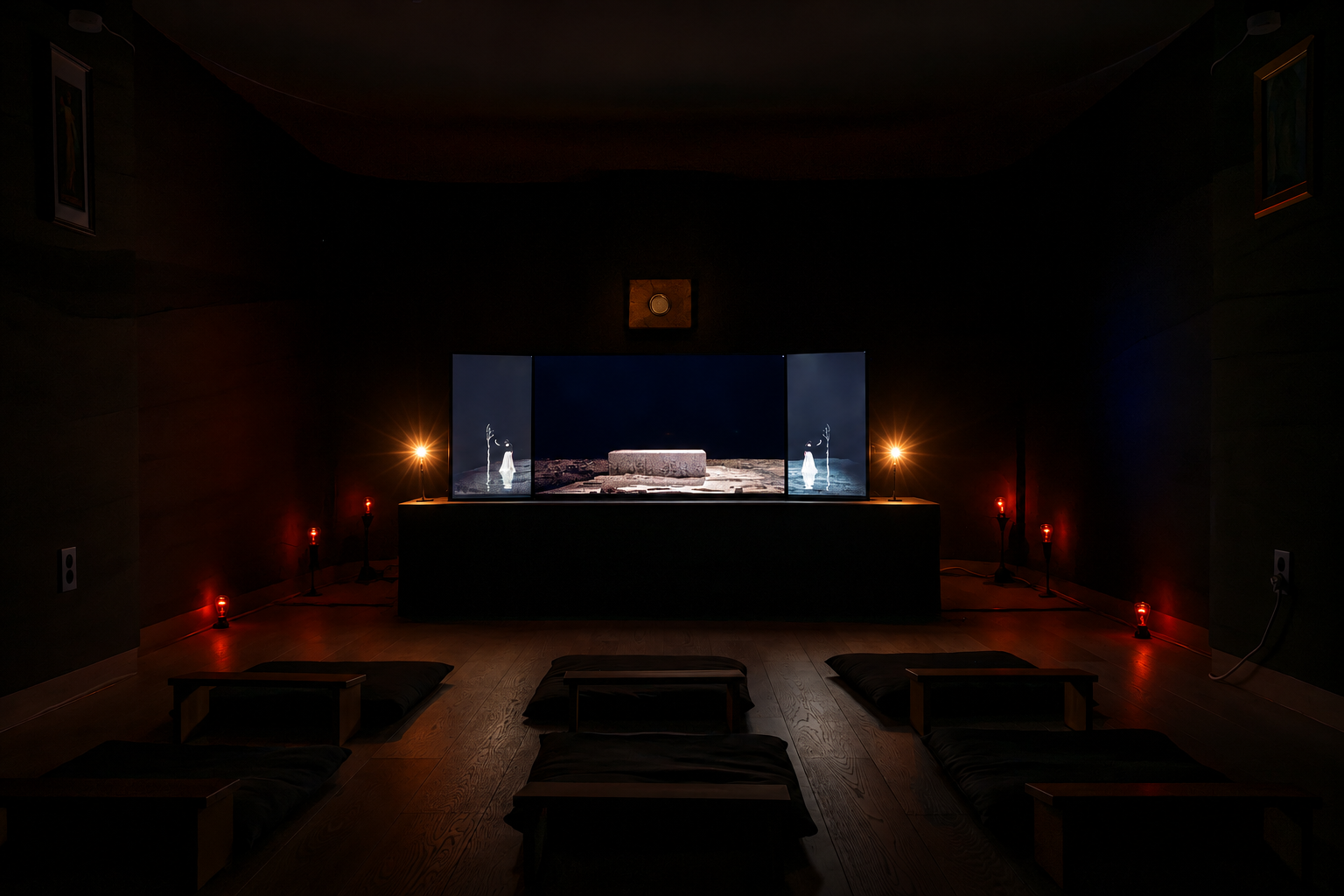
어두운 화면 한가운데, 돌 위에 천으로 싸인 몸이 놓여 있다. 조금씩 빛이 들어오다가 작은 종소리와 함께 천이 떠오른다. 바로 그 순간, 천 아래에 있어야 할 몸이 없다는 사실이 드러난다. 천은 약 1분 동안 상승하고 부유하며 계속 접히고 펼쳐진다. 몸의 윤곽을 보존하지도, 하나의 완성된 형상으로 머물지도 않는다.
내가 만드는 것은 가림막을 걷어 몸을 노출하는 장면이 아니다. 천은 들어 올려지지만 부활한 몸을 시선에 돌려주지 않는다. 그 움직임은 빈 돌을 바라보던 시선을 풀어 주고, 보이지 않는 몸이 앞서 간 방향을 상상하게 한다. 천은 그리스도의 몸이나 인성을 대신하지 않으며, 천의 상승은 그분이 몸을 벗어 버렸다는 뜻도 아니다.
데이비드 벤틀리 하트의 논의는 이 비어 있음을 순수한 부재로 읽지 않도록 이끈다. 빈 무덤은 몸이 폐기되었다는 표지가 아니라, 죽음이 그 몸을 끝내 소유하지 못했다는 표지다. 다만 부활의 충만을 상처가 지워진 승리로 만들 수는 없다. 부활하신 몸에는 못 자국이 남아 있다. 내가 찾는 아름다움은 고통을 덮는 화려함도, 텅 빈 공간 자체를 소유하는 관조도 아니다.
작품에서 천·돌·빛·시간은 이 질문을 함께 사유한다. 긴 기다림과 느린 상승은 감추어진 대상을 단번에 보여주는 대신 시선이 달라질 시간을 만든다. 측면의 두 형상은 몸이 놓였던 자리의 양끝을 표시하고, 영상에 맞춰 켜지는 실제 램프는 화면 밖의 공간과 관객의 몸까지 주의를 확장한다. 램프는 시간에 맞춘 전기적 장치이지 은총 자체를 일으키는 장치는 아니다.
성체조배 경당에 설치될 때, 영상 위의 실제 전례 공간에는 축성된 성체가 현시된다. 화면 속 빈 무덤과 성체는 같은 종류의 시각적 대상이 아니다. 성체는 영상의 빈자리를 채우는 조형물도, 작품이 만든 상징도 아니다. 가톨릭 신앙에서 그리스도의 몸이 성사적으로 실재하는 성체 아래에 영상이 놓이는 것이다. 작품이 성체를 자신의 일부로 소유하는 것이 아니라, 그 현존 앞에서 작품의 이미지와 해석이 판단받는다.
윌리엄스가 강조하는 비소유성과 하트가 말하는 부활의 생명은 이 작품에서 하나의 답으로 봉합되지 않는다. 나는 그 긴장을 천의 움직임 안에 남겨 둔다. 작품은 신학 이론을 설명하는 삽화가 아니라, 천과 돌과 빛과 시간이 그 질문을 감각 가능한 사건으로 만드는 자리다. 천 아래 열린 공간은 부재의 끝이 아니라, 소유할 수 없는 현존을 향해 시선이 움직이는 자리다.
At the centre of a dark screen, a cloth-wrapped body lies on stone. Light gradually enters; a small bell sounds, and the cloth rises. At that instant, the body that should be beneath it is revealed to be absent. For about a minute, the cloth ascends and floats, folding and unfolding. It neither preserves the body’s outline nor settles into a completed form.
I am not making a scene in which a covering is removed to expose a body. The cloth is lifted, yet it does not return the risen body to the gaze. Its movement releases the gaze from the empty stone and invites the imagination toward the direction in which the unseen body has gone ahead. The cloth does not stand for Christ’s body or humanity; its ascent does not mean that he has discarded the body.
David Bentley Hart’s account helps me resist reading this emptiness as pure absence. The empty tomb signifies not the disposal of the body, but death’s failure to possess it. Yet resurrection’s fullness must not become a victory that erases wounds. The risen body still bears the marks of the nails. The beauty I seek is neither a spectacle covering over suffering nor a contemplation that possesses empty space itself.
Cloth, stone, light, and time think through this question together. The long wait and slow ascent allow time for the gaze to change, rather than revealing a hidden object all at once. Two figures in the side panels mark the ends of the place where the body lay. Physical lamps synchronised with the video extend attention beyond the screen into the space and the bodies of those present. These lamps are timed electrical devices, not mechanisms that produce grace.
When installed in the Adoration Chapel, the video sits beneath the consecrated Eucharist exposed in the actual liturgical space. The empty tomb on screen and the Eucharist are not the same kind of visual object. The Eucharist is neither a sculpture filling the image’s vacancy nor a symbol made by the artwork. The video is placed beneath what Catholic faith confesses as the sacramental real presence of Christ’s body. Rather than possessing the Eucharist as one of its elements, the work allows its images and interpretations to be judged before that presence.
The non-possession emphasised by Williams and the life of resurrection articulated by Hart are not sealed into a single answer here. I leave their tension within the cloth’s movement. The work is not an illustration of theological theory: it is a place where cloth, stone, light, and time make the question a perceptible event. The space opened beneath the cloth is not the finality of absence, but a place where the gaze moves toward a presence it cannot possess.
참고문헌과 글의 바탕References and source essay
작가의 논문 「들어 올려진 베일: 로완 윌리엄스, 데이비드 벤틀리 하트, 그리고 빈 무덤」(9월 15일 원고)을 바탕으로 웹페이지에 맞게 재구성했다. 아래는 이 글과 관련된 주요 문헌이다. 천의 움직임과 ‘앞서 가심’을 연결하는 설명은 작가의 작품 해석이며, 성서 본문의 직접적인 주해적 결론과 구분한다.
Adapted for this page from the artist’s essay “The Lifted Veil: Rowan Williams, David Bentley Hart, and the Empty Tomb” (15 September manuscript). Selected references follow. The connection between the cloth’s movement and Christ’s going ahead is the artist’s interpretation of the work, distinguished from a direct exegetical conclusion about the biblical text.
- Williams, Rowan. “Between the Cherubim: The Empty Tomb and the Empty Throne.” In On Christian Theology, 183–196. Oxford: Blackwell, 2000.
- Hart, David Bentley. The Beauty of the Infinite: The Aesthetics of Christian Truth. Grand Rapids: Eerdmans, 2003.
- Quash, Ben. “Brought into the Fold.” In Image as Theology: The Power of Art in Shaping Christian Thought, Devotion, and Imagination, edited by Mark McInroy, Casey Strine, and Alexis Torrance, 181–201. Turnhout: Brepols, 2022.
- Hills, Paul. Veiled Presence: Body and Drapery from Giotto to Titian. New Haven: Yale University Press, 2018.